
The Backyard Poisoner: Death cap mushroom—Jillian Grant Shoichet
“For murderers there is only one mushroom worth considering: Amanita phalloides. Almost everyone who dies from mushrooms dies from it; and most of those who have eaten it have died from it.”
—R. Gordon Wasson[1]
It’s difficult to quell the surge of satisfaction that rises when my research for a Backyard Poisoner column coincides with the accidental or purposeful poisoning of an unfortunate individual (or several) by the same specimen I am writing about.
“Please don’t tell me you’re gloating over another death cap mushroom poisoning,” said my daughter a few weeks ago, looking at me pointedly over the rim of her mug of tea.
“Of course not,” I said, closing the lid of my laptop. “That would make me a monster.”
Truly, I wasn’t gloating. Rather, I was struck by the fact that sometimes all one has to do is think “mushroom” and suddenly every accidental and intentional poisoner seems simultaneously to hitch a ride on the Amanita phalloides train.
I did experience a flash of smug self-satisfaction, common to every amateur forager who has ever struck out into the woods on a bright fall day after a week of rain, inadequately armed with a colour printout and an overdose of hubris—returning with fungal bounty which she then cooked with gross and unwarranted flippancy and ate with oblivious gusto, suffering no ill effects. This is the amateur forager who knows without doubt that whatever she finds, it will be a chanterelle and it will be delicious in an omelette, and she won’t die of liver failure in 7 to 10 days.
I was this amateur forager. I ate this omelette.
Then, a few months ago, I found a death cap mushroom in my backyard and decided to hang up my mushroom foraging hat. I’m all for intentionally crafted digitalis sauerkraut (see “The Backyard Poisoner—Foxglove”). I’m not keen on accidental poisoning by mushroom omelette.
What makes the prospect of accidental mushroom poisoning so horrifying is precisely the joy with which a forager sets off on a forage. Some of my best memories of early adulthood are of mushrooming with family in the woods behind the family home, laying out the golden trove along the counter to dry, stuffing a Thanksgiving turkey with mushrooms and onions and herbs, trying to identify the specimens we didn’t recognize. We joked about death caps (the first death cap ever identified in British Columbia was discovered in 1997, a few kilometres from my childhood home, around the same time I was foraging with family in the woods[2]), but none of us had seen one in real life and likely wouldn’t have been able to identify it if we had.[3]
It’s tricky to identify a death cap even when you know what to look for; if you cut the stalk at the base (as you would for an edible mushroom), then you may not be able to identify the death cap at all. The telltale “cup” or “egg sack” out of which the stem of the death cap grows (one of the few features that definitively distinguishes the death cap from similar-looking edible mushrooms) is at the very base of the stalk—even below ground in some cases.
The backyard poisoner should keep these handy reference points in mind: The mature death cap mushroom is large, its cap up to 15 centimetres across. The stem is white or white-yellow, the cap (rounded when young and flattened with age) is sometimes shaded with green or brown. Aside from the cup at the base of the stalk, mature death caps also have a skirt-like ring around the stem.[4]
I am squeamish when it comes to the death cap, particularly when I dig one up in my own garden, but no series on poisonous plants is complete without a discussion of Amanita phalloides, the mushroom responsible for 90 percent of all mushroom poisoning deaths in the world.[5] As a poison, the death cap is efficient, with a variously estimated 10 to more than 50 percent mortality rate, possibly as high as 90 percent, at a moderately low dose.[6] To the cautious backyard poisoner, these odds may seem uncertain (they’re not 100 percent), but keep in mind that most people who ingest death cap mushrooms do so accidentally and recognize early on they’ve made a grave error, presenting themselves at the emergency room very keen to survive the event. Thirty grams of death cap can kill, meaning that a fatal dose is a half-cap of a mushroom. As toxicity remains the same whether the mushroom is raw, cooked or dried and crumbled atop a chocolate mousse, it’s possible that even a dusting of death cap across dessert will have fatal consequences, depending on the size of the dusting and the size of the individual consuming dessert.
Mortality rates go up when doses are very high, particularly if the victims are unaware that medical intervention is immediately necessary or—heaven forfend—find themselves in situations where medical care is inaccessible for the first crucial hours. For not only does risk of death increase with a higher dose, but the outcome depends on lapsed time between ingestion and medical intervention.[7] Even if the individual receives treatment in short order, death is still possible. In the words of Dr. Ian Musgrave, a molecular pharmacologist at the University of Adelaide, antidotes to amatoxin (the primary toxin in death cap mushrooms), “are mostly not very good.”[8] In a recent case of intentional death cap poisoning in Australia, for example, four adults received several days of aggressive treatment—beginning within a few hours of ingestion and, in one case, culminating with a liver transplant—and three of the four victims died, including the one who received the transplant.[9]
From the backyard poisoner’s perspective, part of what makes the death cap so appealing is its duplicity. First, at various points in its maturation cycle, the death cap looks similar to edible mushrooms (adult death caps can be mistaken for straw mushrooms, from Asia,[10] and juveniles are not unlike puffballs).
Second, initial poisoning symptoms are easily mistaken for a gastrointestinal bug. If mushrooms are part of the meal but not star of the show, the victim may not realize his stomach upset is due to something he ate rather than someone he sat next to at lunch.
Third, the victim often—briefly—gets better, by far the most attractive element of death cap for the poisoner who prefers a certain orchestral evolution to her poisonings: murder in three movements, if you will. After an initial period of illness, the victim often rallies, decides the flu bug has passed and there’s no need for medical attention after all. He might get out of bed, send an email, take a shower. Then, in the final resounding conclusion to the concerto, the liver shuts down and the victim dies of multiple organ failure.
Since their first appearance in the US (in the 1930s, likely having arrived from Europe on the roots of imported trees), death caps have spread throughout southern coastal British Columbia.[11] They prefer the base of broad-leafed deciduous trees (typically European oak and beech, but also sweet chestnut, hornbeam, hazelnut, and linden), establishing a symbiotic relationship with the trees’ root systems. They absorb sugars from the trees and in turn expand the trees’ capacity to take in water and other nutrients from the soil.[12] [13] In 2015, the death cap was discovered for the first time growing at the roots of a west coast native Garry oak in Victoria, suggesting that Amanita phalloides has now fully adapted to the local environment.[14]
In the past decade, death caps have become more plentiful as climate change has produced temperate fall weather that is wetter sooner and remains mild for longer periods of time. Between November 2025 and January 2026, the state of California reported 35 cases of poisoning by death cap mushroom. Only three of these were fatal, but as the state typically reports fewer than 5 mushroom poisoning cases annually, the numbers were notable.[15]
Closer to home, a three-year-old on Vancouver Island died of death cap mushroom poisoning in 2016 after eating a mushroom foraged with his family in downtown Victoria. In 2023, another child was poisoned in Vancouver, although not fatally.[16]
Most dramatically, in July 2025, Australian Erin Patterson was convicted of three counts of murder (her mother- and father-in-law and one other relative) and one count of attempted murder (another relative), having served all four victims a lunch of beef Wellington laced with death cap mushrooms.[17]
The backyard poisoner who decides that death cap mushroom is her poison of choice should wait a few months until the uproar in Australia has died down. Then, when she begins to plan her menu, it goes without saying that beef Wellington is forever off the table.
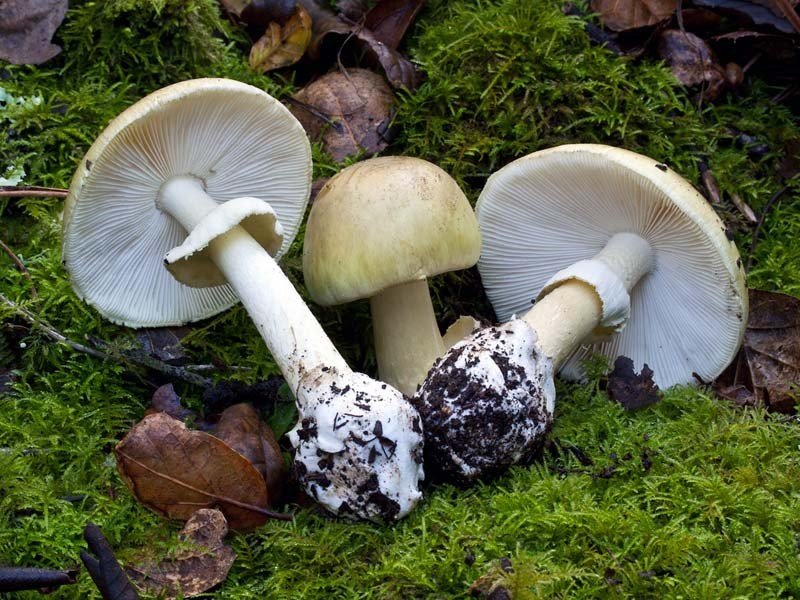
Amanita phalloides
Gardener’s notes:
Don’t plant this. If your trees need a mycorrhizal network to amplify nutrient exchange, they don’t need you to organize it for them.
First responder’s notes:
Abdominal pain, vomiting, and diarrhea. Typically, first symptoms will appear within 4 to 12 hours after ingestion (but may not appear for 36 hours) and then subside after a day. It is imperative that medical support be sought during initial onset or during the period of false remission—as symptoms will reappear within 72 hours, along with symptoms of liver failure (amatoxin inhibits reproduction of the liver cells). Death, if it occurs, is usually 7 to 10 days after ingestion. Most fatalities occur when individuals wait until the second recurrence to seek medical help, by which time liver damage may be extensive and irreversible. There is some evidence that an extract of milk thistle, if administered early, may help protect the liver, but this treatment is still in the experimental stages.
Writer’s notes:
Pro:
A great poison, with proven results. Lots of back-to-the-land culinary interest where mushrooms are concerned. With a little careful planning, very easy to disguise as an accidental death.
Contra:
Following the trial and conviction of Erin Patterson in Australia, everyone is thinking about death cap mushrooms; if you use them, you will likely be accused of being derivative. Wait a bit.
Pathologist’s notes:
Blood and urine samples within 12 to 24 hours of ingestion will show death cap poisoning; after that, results may be inconsistent or inconclusive, and amounts may be negligible. An absence of the toxin doesn’t mean poisoning didn’t occur, perhaps only that samples were collected when toxin levels were too low to detect (for example, during recurrence after false remission).
Murderer’s best-case scenario:
Beef Wellington, hand-prepared with locally sourced and dehydrated death cap mushrooms, lovingly served to family members in a relaxed and rural setting—oh, wait: That’s been done.
Final score (taking into account toxicity, certainty, detectability, and ease of use, including preparation and clean-up): 7/10 (only because the recent media spotlight on death cap mushrooms makes the method seem unimaginative).
[1] Opening lines from R. Gordon Wasson’s “Death of Claudius or Mushrooms for Murderers”, Botanical Museum Leaflets 23 (3), Harvard University (Cambridge, MA): 1972: 101–4. Wasson is one of the Backyard Poisoner’s heroes when it comes to writing about dark culinary pursuits, along with British author John Lanchester, whose Debt to Pleasure perfected the art.
[2] Vancouver Mycological Society, Amanita phalloides, 2026.
[3] If you’re new to the foraging game, I recommend going with someone who knows what they’re doing. I also recommend sticking with chanterelles for your first few excursions, as chanterelles look nothing like death cap mushrooms. The most poisonous chanterelle look-alike, the Jack O’Lantern mushroom, glows in the dark, making it easy to distinguish from the less luminescent chanterelle.
[4] Lisa Johnson, “Deadliest mushroom in world on the rise in B.C.”, CBC.ca, October 11, 2016.
[5] Evan Bush and Aria Bendix, “Another California resident dies of death cap mushroom poisoning”, NBCNews.com, January 9, 2026.
[6] I appreciate that “10 to more than 50 percent ... possibly as high as 90 percent” cuts a wide swath, but estimates vary wildly and outcomes depend on many factors (e.g., dose, time between ingestion and treatment, age, health of the victim, and luck—either “survivor’s luck” or “poisoner’s luck”, depending on your point of view). For various discussions of mortality rates associated with death cap poisoning, see Juliana Garcia et al., “Amanita phalloides poisoning: Mechanisms of toxity and treatment” in Food and Chemical Toxicology 86 (pp. 41–55), December 2015, and the U.S. Food and Drug Administration.
[7] Sara Novak, “What Makes Death Cap Mushrooms the Deadliest in the World?” Discover Magazine, September 20, 2025.
[8] Donna Lu, “Death cap mushrooms: Why are they so toxic and how can poisoning be treated?” The Guardian, August 10, 2023.
[9] “Mushroom Murders: Inside the mind of killer Erin Patterson”, a 7 News Spotlight documentary available on YouTube, July 13, 2025.
[10] BC Centre for Disease Control, Death cap mushroom fact sheet, accessed January 13, 2026.
[11] Vancouver Mycological Society, Amanita phalloides, 2026.
[12] Emily Martin, “Death cap mushrooms are extremely deadly—and they’re spreading”, National Geographic, August 31, 2023.
[13] Much work has been done recently on the mycorrhizal (fungal) network’s capacity to function as a communication corridor as well as a nutrient collection network; in other words, trees may be able to communicate with each other (about environmental dangers, for example) over long distances “by mushroom”. Such a communications network would potentially function as long as the root system still existed—enabling trees on the outer edges of a clear cut or burn area to send information to one another underground, even if, above ground, the trees were no longer thriving. The arguments of environmental scientist Suzanne Simard in Finding the Mother Tree (2021) have since been challenged by others, but no one is disputing the existence of the mycorrhizal network or its capacity to transmit information.
[14] Vancouver Mycological Society, Amanita phalloides, 2026.
[15] Evan Bush and Aria Bendix, “Another California resident”.
[16] CBC News, “British Columbia warned to watch out for poisonous death cap mushrooms”, August 14, 2023.
[17] “Mushroom Murders: Inside the mind of killer Erin Patterson”, 7 News Spotlight.