
The Backyard Poisoner: Yew—Jillian Grant Shoichet
A few years ago, my parents purchased a home 10 minutes away from me, near the ocean on a quiet stretch of road. The house was in a state of disrepair and came with several decades’ worth of junk at no extra cost, a tangled garden, and four Hicks yews.
The yew trees had been left to their own devices for decades. My parents don’t cut down a tree without first undertaking several years of deliberation, so the yews have continued to flourish, far exceeding their deemed “mature” height and girth. They may continue to grow for the next millennium; yews left to their own devices are extraordinarily long-lived.[1]
The Hicks yew (Taxus x media ‘Hicksii’) is fastigiate, or generally columnar. My parents’ trees are about 30 feet tall and 8 feet wide, branch tip to branch tip. They are the first thing that even the not-so-keen observer notices when she turns into the semi-circular drive.
A lethal dose of yew is about 50 grams of almost any part of the tree—seeds, needles, bark—or 3 milligrams per kilogram of body weight[2], assuming 5 milligrams of taxine per gram of yew.[3] (Taxine alkaloids are the toxic chemicals in yew.) It’s not unreasonable to estimate that my parents have, at their front doorstep, the means to murder most of Earth. When they brought home another 12 yew trees in pots to set up on the deck, I asked them which other planetary populations they had in mind. My query was facetious, of course. There’s no current evidence to suggest that yew is lethal to non-Earth life forms. But I gently suggested they take steps to reduce the risk of accidentally poisoning their human grandchildren.
My parents don’t implement suggestions from me without first undertaking several years of deliberation, so I view it as significant that the 12 yews in pots did not make an appearance on the deck the following season.
Etymologically, it’s not a big leap from the Latin taxus to the English toxic. But the yew’s Latin name is likely borrowed from the Greek τόξον (tóxon). The Greeks in turn probably pinched the word from the Scythian taxša, meaning “bow”[4]; yew has long been favoured for crafting javelins and bows—truly, a multipurpose killing tool.
But for the backyard poisoner, the yew’s toxicity is one of its most attractive qualities, along with its regal beauty and appeal to various birds (waxwings, thrushes, and the decorative but highly territorial redwing blackbird). Birds like the aril, a fleshy casing around the yew seed; the aril is the only part of the tree that isn’t poisonous. Birds pass the highly poisonous seeds undigested, whereupon[5] the seeds sprout elsewhere, dispersing the yew’s elegant, deadly cheer.
In ancient Greece, the yew tree was associated with Hecate, goddess of witchcraft and necromancy. Boughs of yew purified the dead as they entered Hades. First-century Roman poet Statius writes of a hero whose life was taken so quickly that “not yet had the Fury met and purified him with branch of yew.”[6] Shakespeare’s witches famously added “…, slips of yew / Sliver’d in the moon’s eclipse” to their noxious brew in Macbeth (Act IV, Scene I).
There is some evidence that yew was used historically for euthanasia and suicide, particularly during wartime, when some conquered peoples chose to ingest yew as an alternative to being killed or enslaved. The most famous of these cases is possibly that of Boudica, warrior queen of the Brittonic Iceni tribe, who is said to have taken yew following defeat by the Romans, preferring to die by her own hand.[7]
The tree is often found growing in or near graveyards in western Europe and the British Isles. The Fortingall Yew in Perthshire, Scotland, and the yew in St Cynog’s churchyard in Defynnog, Wales, both estimated to be 5000 years old, are two of the most well known of these cemetery yews.[8][9] One can imagine that Christian cemeteries were established around ancient yew trees precisely because these sentinels already served as guardians of the boundary between this world and the next. In fact, the yew’s integral role in pagan belief systems saw some leaders of the Catholic Reformation attempt to ban tree-planting altogether.[10]
But our relationship with the yew has persisted, despite periodic assault. Today, the Ancient Yew Group, a conservation society based in the UK, maintains an online interactive map locating more than 2500 ancient yews across Britain, France, and Spain.[11] A petition to protect these natural wonders has garnered more than 300,000 signatures since 2018.[12]
Unsuccessful treatments for yew poisoning have been around for almost as long as we’ve been poisoning ourselves with yew. One nineteenth-century physician recounts how a four-year-old patient who had ingested “many of the berries and nuts of the yew” underwent an aggressive course of emetics, purgatives, and leeches “applied to the head”, only to die 19 days later, with a host of horrifying symptoms and “pain to the last.”[13] Contemporary clinicians have tried atropine, lidocaine, sodium bicarbonate, and hemodialysis, all with little benefit. In some cases, life support seems to be the only deciding factor in the patient’s weathering an otherwise dire medical event.
From the perspective of the victim, a positive medical outcome is more likely in cases of accidental ingestion, where toxicity is less extreme and life support may offer the body an opportunity to recover. From the perspective of the poisoner, a positive outcome is more likely if the victim eats a significant portion of yew in a short space of time. If yew is the poison of choice, then the savvy backyard poisoner will choose a victim who likes eating.
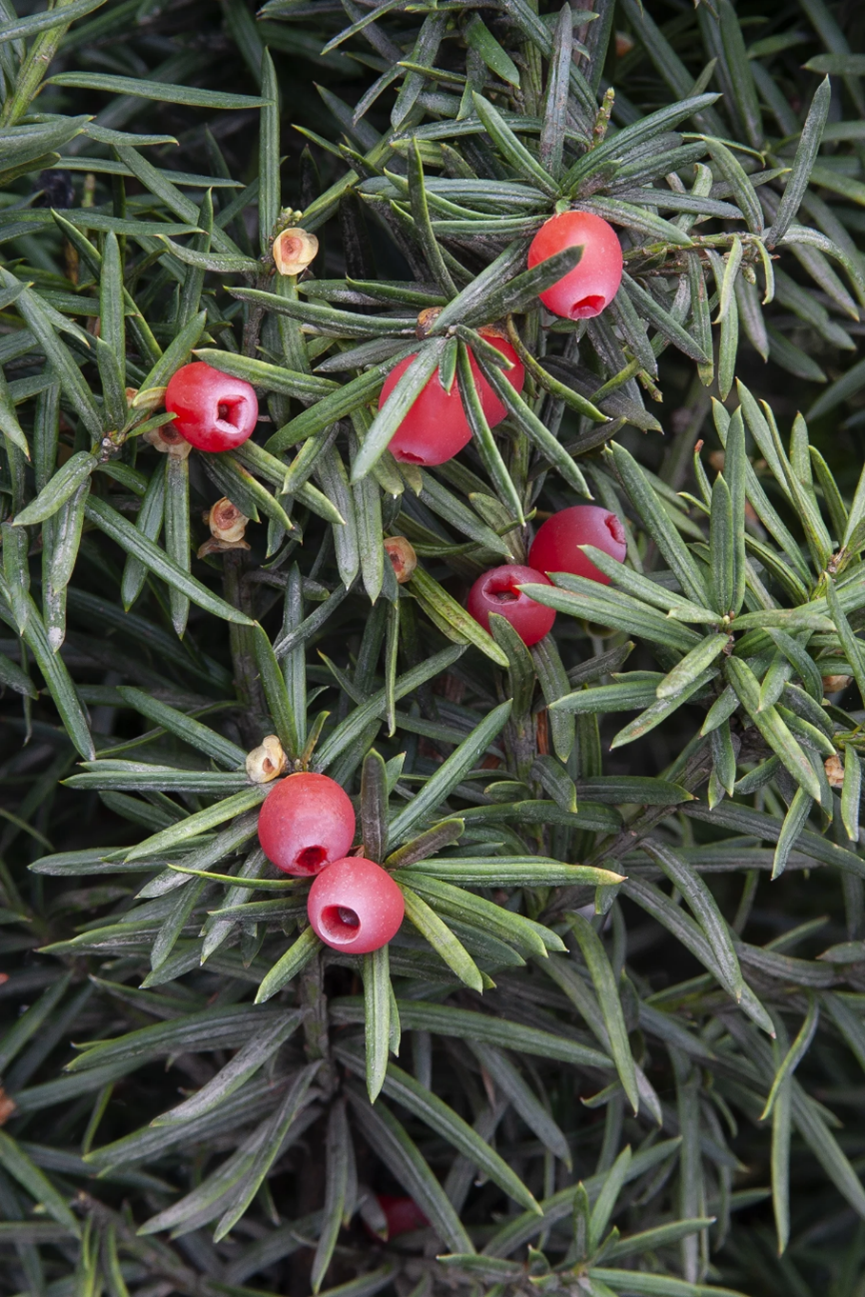
Taxus x media ‘Hicksii’
Gardener’s notes:
A stately conifer, providing height and structure. Bright red arils offer a pop of colour, particularly in late summer and early autumn; soft green needles are typically darker on the top side and lighter on the underside, providing nice contrast. Attractive to birds as both a food source and for nesting.
First responder’s notes:
First responders may not attend at all, as some cases of yew toxicity are asymptomatic until the victim’s heart stops. If symptoms appear, they may present as nausea, vomiting, and abdominal pain[14]. Later symptoms will include bradycardia (abnormally low resting heart rate, perhaps with a bluing of the lips), arrythmia, and, eventually, cardiac arrest.[15]
Writer’s notes:
The most efficient method of delivery is an eating competition: ice cream or hot dogs heavily infused with yew. This ensures a high quantity of taxine is ingested in a short span of time, with initial symptoms of toxicity easily (mis)identified as symptoms of gluttony rather than symptoms of poisoning. By the time observers realize heartburn is not the cause, the outcome will have been determined.
Pro:
If the victim ingests enough yew, fatality is certain.
Contra:
For a certain outcome, the victim must ingest a significant amount of yew and then do nothing about it for a significant amount of time.
Pathologist’s notes:
If death occurs relatively soon after ingestion, identification of plant parts in the digestive tract will be critical for identifying cause of death. Poisonings by yew leaves, pulp, seeds, and bark have been determined by post-mortem examination. Recognizing toxicity due to yew leaf tea is more difficult because there are no botanically identifiable parts.
Murderer’s best-case scenario:
A county fair, in which the highlight of the weekend is the ice cream eating competition, sponsored this year by the new ice creamery in town, known for its inventive use of natural ingredients. Each participant is served a 5-litre tub of ice cream, flavoured with rosemary or lavender and locally sourced honey—except for one participant, whose portion contains a large amount of yew. Stomach upset following the competition is not unusual. Each year, participants fully expect to feel at least some abdominal pain following the gastronomic event, and the local medical clinic always sees at least some of the competition’s participants within a few hours after the winner is crowned.
Final score: 9/10
[1] Rory Morrow, “Ancient Yew Trees: The UK’s Oldest Yews”, Woodland Trust, 2025.
[2] Max for Plantura Magazine, “Yew Trees: poisonous to humans and animals”, n.d.
[3] ACEP Toxicology Section, “(Don’t) do the yew”, February 11, 2021.
[4] See “taxine” at EtymOnline.
[5] There are so few instances in modern literature to use “whereupon” that I consider it my duty to do so wherever possible.
[6]Thebaid, Book 8, translated by J.H. Mozley.
[7]Boudican revolt; see also MarthaVandrei, Queen Boudica and Historical Culture in Britain: An Image of Truth (Oxford, UK: 2018); and Graham Webster, Boudica, the British revolt against Rome AD 60 (Totowa, NJ: Rowman and Littlefield: 1978).
[8] Forestry and Land Scotland, “Yew”.
[9] Lucy John, “The mind-blowing secrets of Wales’ ancient trees planted by people 5000 years ago”, WalesOnline, August 6, 2023.
[10] From Thomas Laquer’s Work of the Dead: A Cultural History of Mortal Remains (Princeton University Press, 2015), excerpted in The Paris Review, October 31, 2015.
[11] See The Ancient Yew Group.
[12] See the petition to save Britain’s ancient yew trees.
[13] John Lloyd. “Case of Poisoning by Yew Berries”. Prov Med Surg J. 184, 12(24): 661-62.